Expression Regulation Scale
ERSA 24-item instrument measuring expressive norms (display rules) across three emotion domains — affiliative, vulnerable, and disruptive — indexing the degree of suppression through amplification, and designed to be administered across social situations.
Overview
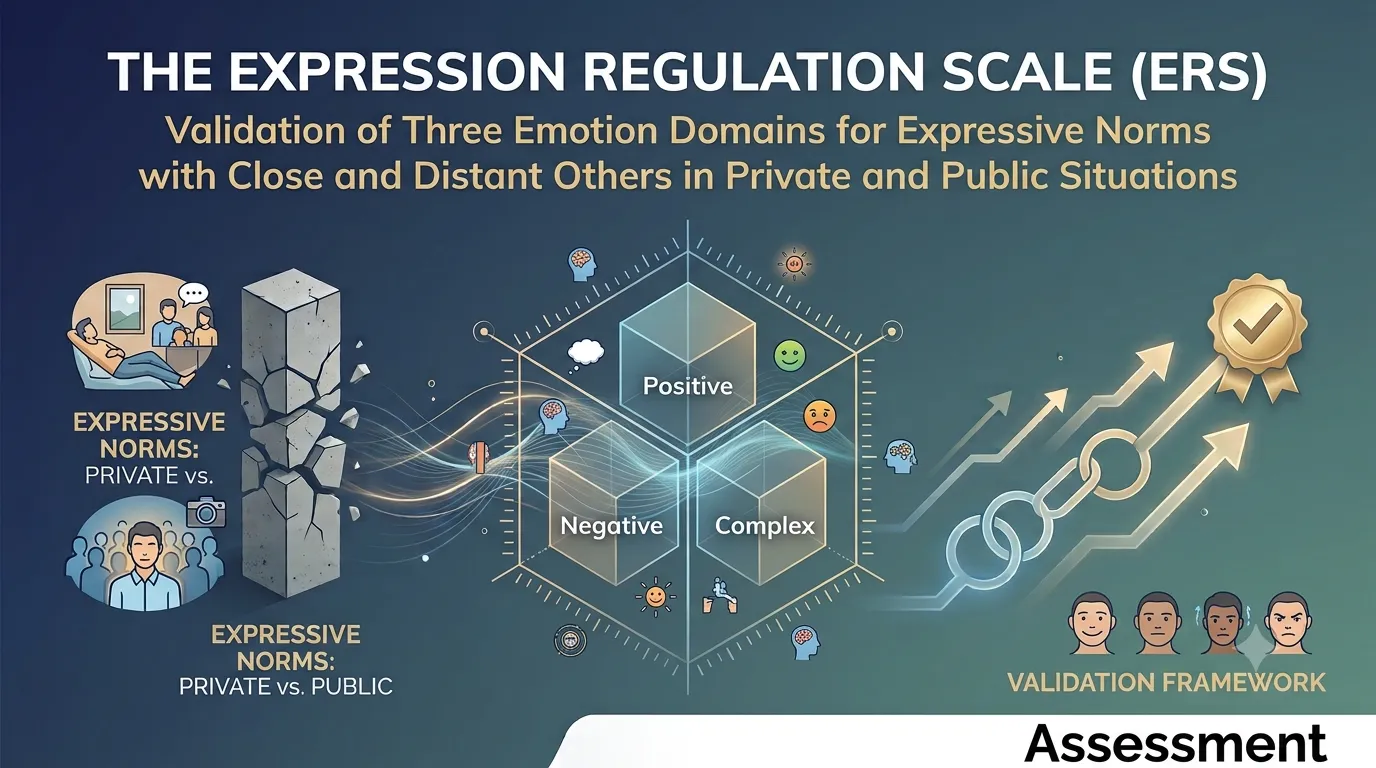
The Expression Regulation Scale (ERS) measures the social norms that guide emotional expression — “display rules” — across a comprehensive, theory-based emotion space. Derived from an initial pool of 64 emotions using ant colony optimization (ACO) to identify a psychometrically robust, cross-situationally invariant item set, the final scale distils expression regulation into three domains that reflect the social function each emotion serves. Uniquely, the ERS captures the full bipolar range from suppression to amplification on an intuitive visual analog metric, and is designed to be administered across social situations defined by setting (private vs. public) and interactant closeness (close vs. distant).
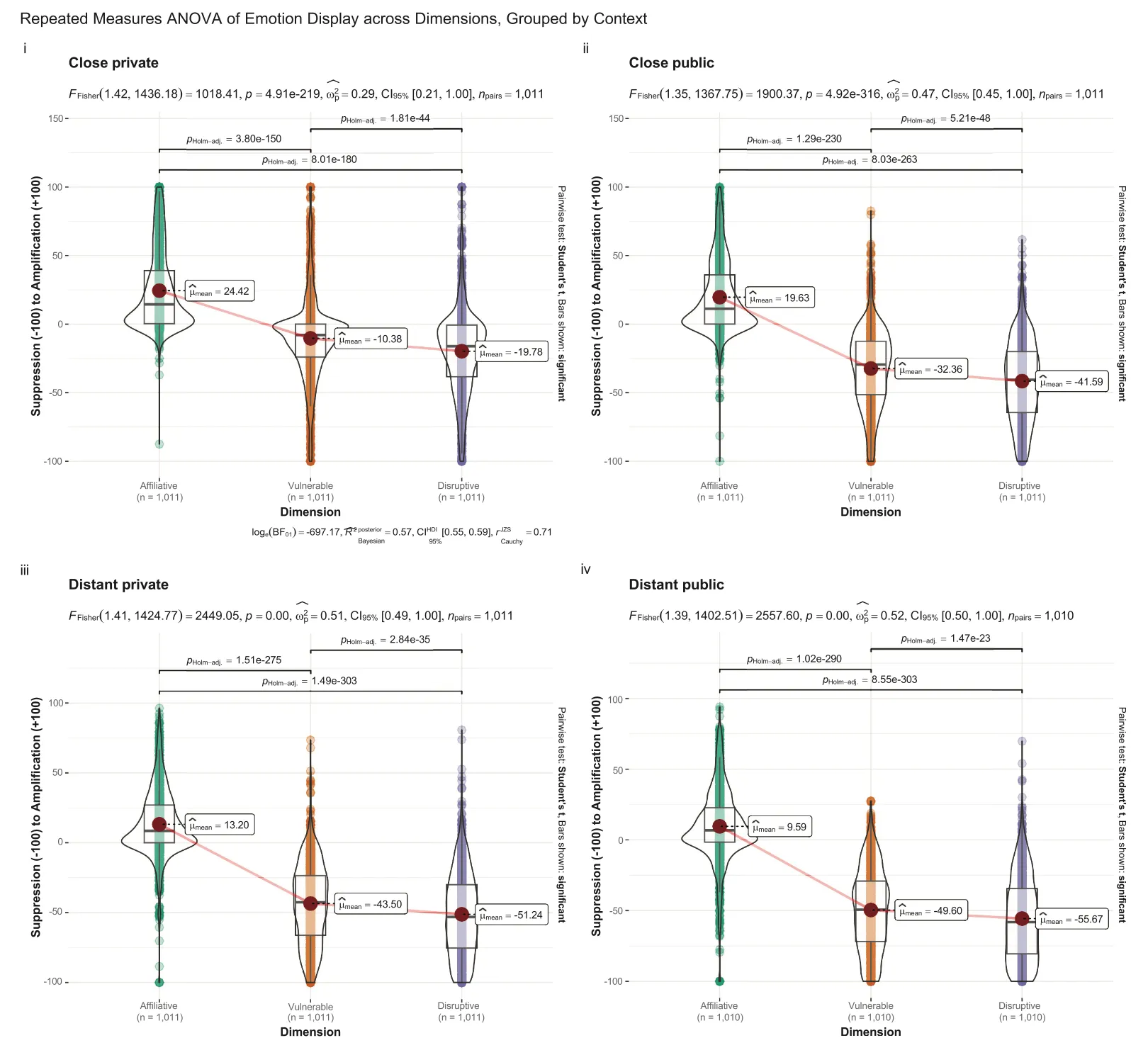
- Affiliative: Emotions serving social harmony and bonding (e.g., happiness, compassion, admiration). Typically expressed as felt or amplified, with strong aversion to suppression.
- Vulnerable: Emotions signalling vulnerability and requesting support (e.g., sadness, fear, guilt). Generally suppressed, particularly in public or with distant others.
- Disruptive: Emotions regulating social power/status with potential to disrupt (e.g., anger, contempt, resentment). Most strongly suppressed, especially in public with distant interactants.
Vulnerable and disruptive domains are empirically close (both negatively valenced) but retained separately for theoretical reasons, including gendered display-rule hypotheses; affiliative is essentially orthogonal to both.
Items
The 24 items are emotion terms (eight per domain). For a given situation, participants rate how much they think they should express each emotion, from Express no emotion/hide my emotion completely (–100), through Express it as I feel it (0), to Express much more than I feel (+100). Situations are operationalised via a framing prompt combining setting (private/public) and interactant (close/distant); the wording can be adapted to target actual or habitual expression.
Affiliative Domain
- Compassion
- Delight
- Happiness
- Excitement
- Admiration
- Hope
- Pleasure
- Pride
Vulnerable Domain
- Distress
- Embarrassment
- Guilt
- Fear
- Despair
- Hurt
- Sadness
- Unhappiness
Disruptive Domain
- Boredom
- Disgust
- Hatred
- Fury
- Anger
- Irritation
- Jealousy
- Resentment
Scoring
- No reverse scoring. The response metric is inherently bipolar.
- Domain Scores: For each situation, calculate the mean of the eight emotion ratings within a domain.
- Interpretation of the metric: Positive scores indicate the degree of amplification, negative scores the degree of suppression, and scores around zero indicate expressing the emotion as felt (little to no regulation).
- Cross-situation comparison: Because scalar invariance holds across the four situations, latent means can be compared directly across setting and interactant conditions.
Interpretation
- Affiliative: Norms cluster from express-as-is to amplification across all situations; suppression is rarely endorsed. Amplification is greatest in close-private settings.
- Vulnerable: Norms tend toward suppression across situations, most pronounced in public and with distant others, though close-private is more symmetric.
- Disruptive: Norms tend toward suppression more strongly than vulnerable emotions, with the sharpest suppression in public–distant situations.
- Both interactant and setting exert significant main effects; interactant × setting interactions are significant for vulnerable and disruptive domains but not affiliative.
Citation
Monaghan, C., Shou, Y., Mewton, P., Quayle, A., & Dawel, A. (2026). The Expression Regulation Scale (ERS): Validation of three emotion domains for expressive norms with close and distant others in private and public situations. Assessment, 33(3), 439–457. https://doi.org/10.1177/10731911251333664
Supporting figures