Bodily Sensations Response Scale
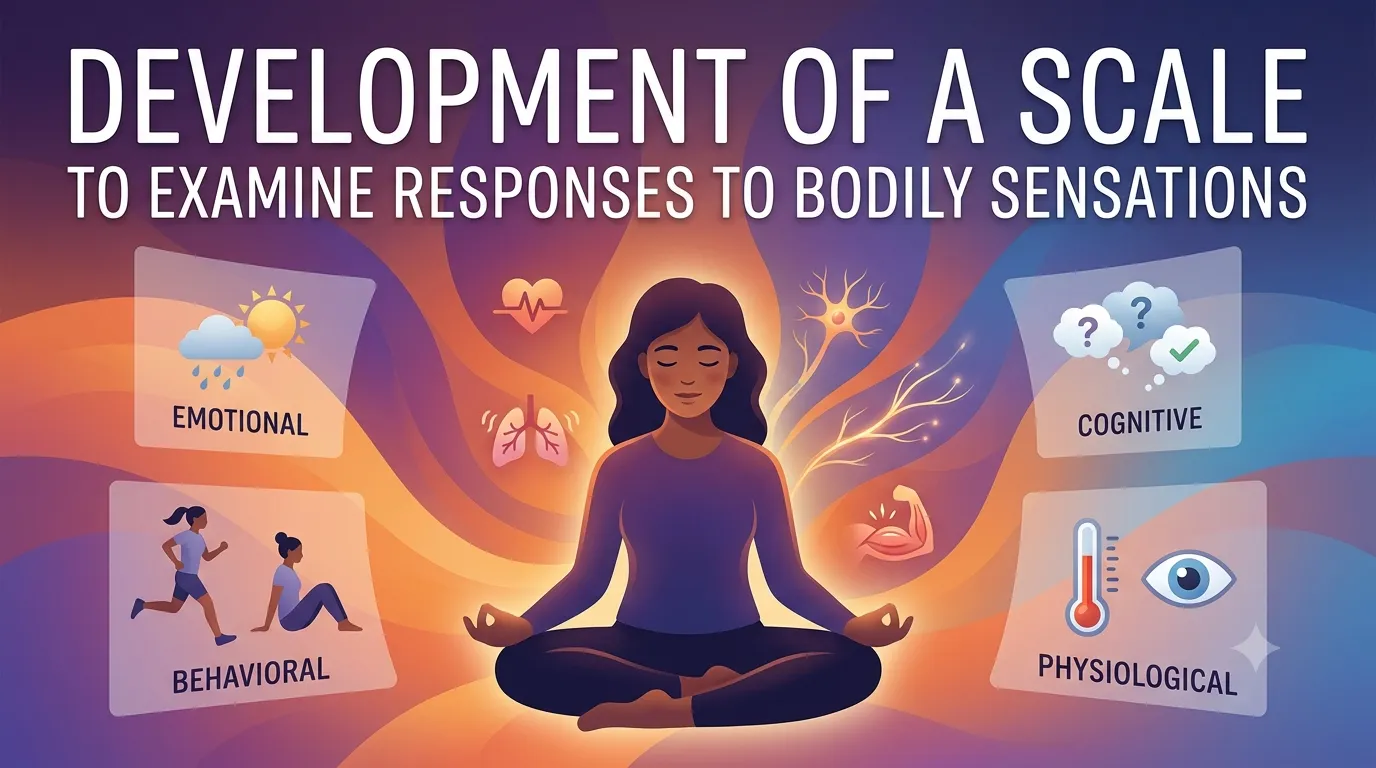
BSRSA 27-item instrument measuring people's psychological (cognitive, emotional, and behavioral) responses to everyday bodily sensations across two dimensions: defeat and acceptance.
Overview
The Bodily Sensations Response Scale (BSRS) was developed to capture how people psychologically respond to all everyday bodily sensations, not just the aversive, anxiety-related sensations targeted by earlier measures (e.g., BSQ, BSIQ, ASI). Adapted from the Tinnitus Response Scales (Croft et al., 2013a), it broadens the response space to cognitive, emotional, and behavioral reactions and spans negative, neutral, and positive valence. A putative four-factor model (defeat, effortful control, acceptance, sensitization) reduced empirically to two robust, strongly negatively associated dimensions.
- Defeat: A negative cognitive, emotional, and behavioral response marked by persistent awareness of the sensations, perceived threat, helplessness, despair, distress, impaired concentration, and low perceived control. Linked to heightened interoceptive sensibility, autonomic reactivity, and affective distress.
- Acceptance: A neutral response reflecting reduced awareness of the sensations, willingness to let them be, and little need to control or react to them. Largely independent of interoceptive sensibility and psychopathology.
Items
We would like to know how you currently experience your bodily sensations. Bodily sensations are feelings from your body that include rapid heartbeat, butterflies in the stomach, muscle tension, feeling out of breath, feeling flushed, bloated, relaxed, fatigued, burning, itching, hungry, or thirsty. Please select the rating that best describes how often you experience the bodily sensations in the way described (0 = Never, 1 = Occasionally, 2 = Sometimes, 3 = Usually, 4 = Always).
Defeat Subscale
- Item 1: I feel defeated by my bodily sensations.
- Item 2: It distresses me that my bodily sensations prevent me from enjoying life.
- Item 3: It takes effort to maintain concentration due to my awareness of the bodily sensations.
- Item 4: I feel helpless because of my bodily sensations.
- Item 5: My bodily sensations are the worst thing that has happened to me.
- Item 6: My bodily sensations last for a long time.
- Item 7: I cannot concentrate on anything because of my bodily sensations.
- Item 8: My bodily sensations distract me from doing other things even if it is important.
- Item 10: My bodily sensations have ruined my life.
- Item 12: I despair because of my bodily sensations.
- Item 13: It is difficult to accept that I will always have the bodily sensations.
- Item 19: It is difficult to accept my bodily sensations.
- Item 20: My bodily sensations have negatively influenced my close relationships.
- Item 22: I think I cannot take my bodily sensations anymore.
- Item 23: My bodily sensations are all too much.
- Item 25: I am worn down by my bodily sensations.
- Item 26: Focusing on my bodily sensations will eventually threaten my mental health.
Acceptance Subscale
- Item 9: I become less aware of the bodily sensations as time goes by.
- Item 11: I get used to particular bodily sensations.
- Item 14: I willingly accept my bodily sensations.
- Item 15: I simply let my bodily sensations be there in the background.
- Item 16: I am not aware of my bodily sensations when I am working.
- Item 17: I can feel peaceful and be aware of my bodily sensations.
- Item 18: I can get on with what I am doing despite the bodily sensations.
- Item 21: I do not try to control my bodily sensations.
- Item 24: Despite being aware of the bodily sensations, I can concentrate on tasks without needing effort or will.
- Item 27: I do not need to suppress or block out my awareness of the bodily sensations.
Scoring
- No reverse scoring. Each subscale is keyed in its own direction; Defeat items index a negative response and Acceptance items index a neutral/accepting response.
- Subscale Scores: Calculate the mean or sum of the designated items for each dimension:
- Defeat: Items 1, 2, 3, 4, 5, 6, 7, 8, 10, 12, 13, 19, 20, 22, 23, 25, and 26 (17 items).
- Acceptance: Items 9, 11, 14, 15, 16, 17, 18, 21, 24, and 27 (10 items).
- Score ranges (sum): Defeat 0–68; Acceptance 0–40. The two subscales are analysed separately rather than combined into a total.
Interpretation
- High Defeat: Indicates persistent awareness of and preoccupation with bodily sensations, perceived threat, resignation, and low perceived control. Associated with elevated interoceptive sensibility (especially autonomic-arousal sensations), depression, anxiety, stress, and self-reported mental health problems. Younger participants reported higher Defeat than older participants.
- High Acceptance: Reflects a neutral, non-reactive stance toward bodily sensations with reduced awareness and little associated distress. Generally unrelated to interoceptive sensibility and affective distress; older participants reported higher Acceptance.
Citation
Roche-Freedman, K. E., Brown, R. F., Monaghan, C., Thorsteinsson, E., & Brown, J. (2023). Development of a scale to examine responses to bodily sensations. Psychological Reports, 126(5), 2564–2593. https://doi.org/10.1177/00332941221074262